At Accesio, we know accessibility requirements aren't one-size-fits-all. As an Alberta-based company, we help businesses understand local codes and find automatic door activation solutions for their spaces. If you’re planning a new installation or upgrading an existing building, here is what you need to know about Canadian accessibility standards, especially in Alberta.
Understanding Federal Accessibility Requirements
Federal accessibility standards apply to federally regulated organizations and facilities, not just any publicly accessible building. Examples include federal government buildings and Canada Post facilities. Accessibility Standards Canada's CAN/ASC 2.3 Model Standard for the Built Environment provides guidance for federally regulated organizations on accessible building design, including power-operated doors, activation controls, doorway clearances and signage. The standard is currently in draft development, with final publication expected in Fall 2027. While it is not a universally enforceable building code, it provides a useful reference for organizations planning accessible entrances that want to be future-proofed for upcoming code revisions for federal facilities in Edmonton.
Alberta Accessibility Requirements
For Alberta property owners and businesses, a key reference is the National Building Code - 2023 Alberta Edition. Alberta adopts the National Building Code with provincial amendments. Section 3.8 outlines barrier-free design requirements, including specific rules for power-operated doors.
Under
Section 3.8.3.6, power-operated doors must activate automatically or through accessible controls. Where controls are used, they must meet several criteria:
- Controls must include two activation height ranges. They must be operable between 150 and 300 mm above the finished floor, as well as between 900 and 1,100 mm. The lower range supports wheelchair access, while the higher range accommodates other users. This does not necessarily require two separate buttons: some vertical, column-style actuators have an extended surface that accommodates both ranges.
- Controls must be easy to operate. A person must be able to activate the door by touching or approaching any part of the surface with a fist, arm or foot. Users should not have to apply significant force or need to grip or twist to activate the door.
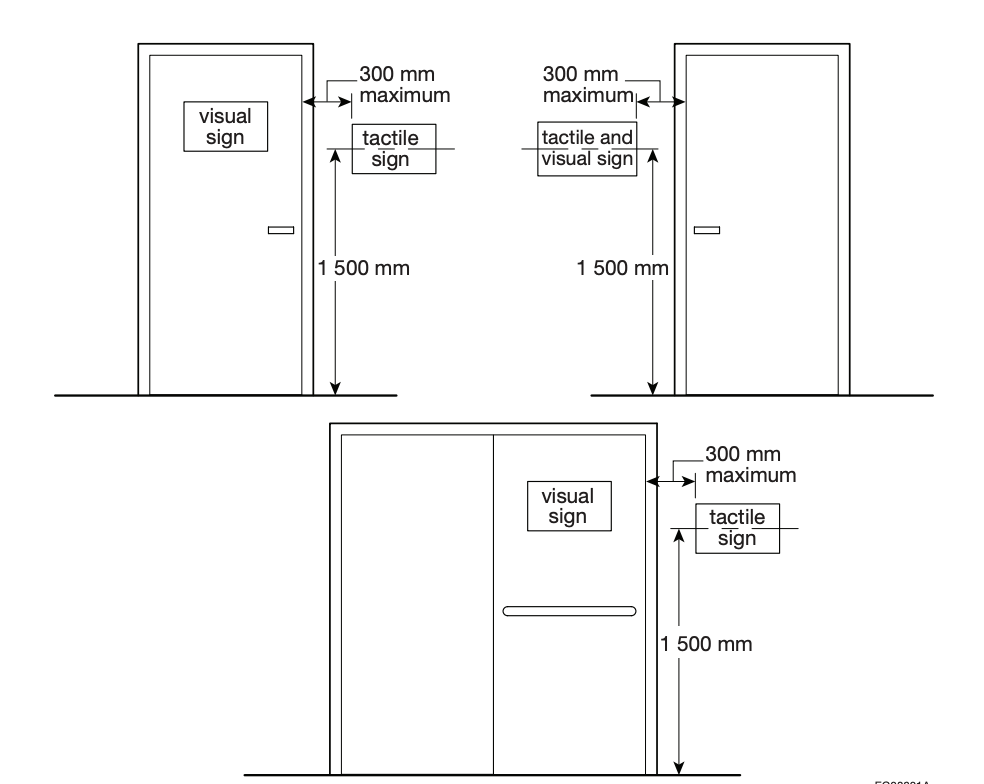
- Controls must be located along a barrier-free path of travel, clearly marked with the International Symbol of Access and positioned clear of the door swing. They cannot be located more than 1,500 mm away from the door swing.
- Finally, unless equipped with safety sensors, the door must take at least 3 seconds to fully open and require no more than 65 N of force to stop its movement.
Additional considerations also apply to door safety. For example, Alberta's building code requires a cane-detectable guard on the hinged side of power-assisted doors that swing open into a barrier-free path of travel.
How do requirements differ across Canada?
Although many provinces use the National Building Code as their starting point, each jurisdiction adopts its own edition and may introduce provincial amendments. This means requirements for accessible door controls can differ across Canada.
- British Columbia:
The 2024 BC Building Code requires activation controls to be operable at both 150–300 mm and 900–1,100 mm above the floor. It also requires controls to be located at least 600 mm and no more than 1,500 mm beyond the door swing, in the direction the door opens toward the control.
- Saskatchewan:
Saskatchewan adopted the 2020 National Building Code of Canada, effective January 1, 2024, with provincial amendments. It follows similar power-door controls as Alberta, including button height requirements.
- Ontario: The Ontario Building Code permits either a conventional control with its centre between 900 and 1,100 mm above the finished floor, or an extended vertical control spanning from no more than 200 mm to at least 900 mm.
A solution that meets requirements in one province may not automatically meet the rules in another. Before selecting or installing an actuator, confirm which code and edition apply in your region and work with a professional company that knows the code for your province and city.
Choosing the Right Accessible Door Controls
Meeting accessibility requirements is about more than checking a box. An effective activation system should be easy to find, straightforward to use, and positioned so people can operate it comfortably without interfering with the doorway or door movement.
At Accesio, we specialize in accessible door activation solutions for Alberta businesses. Our understanding of provincial requirements can help you choose a control that suits your entrance and supports a more accessible space. If you are unsure which control is right for your project, start by reviewing the applicable code and the layout of your entrance. Getting advice early can help avoid costly adjustments later and make it easier for more people to enter and use your building independently.